

Bankers know all too well the many ways a deal can go south. One of the most common, underestimated, and preventable is a weak finance function.
This is most often true in the lower-middle market, when sellers are:
→ Founder led
→ Operating with lean finance teams
→ Lacking a robust FP&A data layer and supporting models
→ Unaudited or lightly reviewed
Many of these businesses are strategically and operationally attractive to buyers. It’s just that finance and accounting infrastructure hasn’t kept pace.
This puts a sell-side process at undue risk.
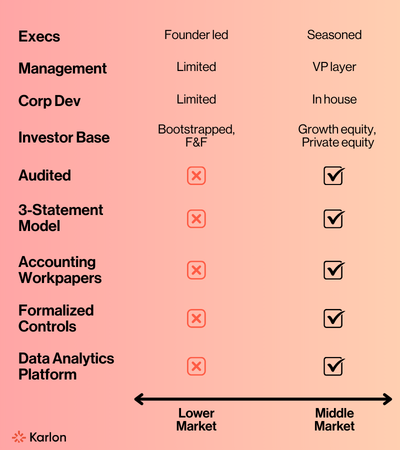
Every transaction involves information asymmetry. Buyers inherently know less about the business than sellers. This is called the “information gap” and its a fundamental reality of acquiring a business.
In practice, this often surfaces as:
Finance
→ Impossible-to-audit P&L forecast lacking clear drivers
→ Rudimentary balance sheet modeling
→ Limited operational metrics and analytics
Accounting
→ Financial statements that require significant cleanup or reconciliation
→ Inconsistent revenue recognition or expense classification
→ Minimal internal controls or repeatable accounting processes
When the information gap stays wide, buyers’ posture shifts. Deal dynamics go from urgent confirmation to skeptical investigation. Diligence lists expand. Timelines get delayed. Eventually buyers walk away.
Even in the absence of actual “ accounting skeletons”, inconsistent or poorly supported financials create perceived risk. And perceived risk often translates into valuation pressure, [extended holdbacks], retrades, or dead deals.
QoE reports are often viewed as the solution to these concerns. In reality, they’re usually prepared too late in the process to save a bad deal. The main purpose of a QoE is to identify non-recurring, non-cash, non-core transactions that impact earnings. They don’t remediate underlying weaknesses in real time.
If a QoE analysis uncovers inconsistent policies, unsupported adjustments, or unreliable reporting, it can amplify buyer concern at a critical stage of the transaction. By the time confirmatory diligence is underway, buyers have already formed an investment thesis. Any cracks in financial credibility at that stage are difficult to repair.
The more effective approach is proactive preparation.
When a seller enters the market with:
→ An investor-ready operating model
→ Clean financial statements
→ Data analytics that substantiate the growth narrative
Sellsides get more competitive. Diligence becomes a validation exercise. Positioning and narrative become more convincing. Buyers want to close with urgency.
For lower-middle market bankers, the difference means everything.
Getting the detailed work done before sellside kickoff matters. Clean data, coherent models, and well-organized support schedules reduce noise and allow buyers to focus on the underlying merits of the business.
At Karlon Group, our team brings experience across investment banking, public accounting, and operational finance. We partner with investment bankers to make sure sellers are M&A ready. Learn more about Our Capabilities.
Karlon Group’s work typically includes:
- Cleaning up reporting, reconciliations, and workpapers before confirmatory diligence beginsA good budget aligns the business around those tradeoffs. But with so many variables in motion and so many stakeholders involved, it’s easy for the process to drift off course early.
- Serving as a conduit between bankers and operators to build and package data sets that align with the equity story
- Developing financial models with appropriate operational granularity
- Preparing analytics to support key drivers such as customer acquisition, retention, NRR, churn, and contribution margins
About the Author:
Karsten Loose is co-founder and Managing Partner at Karlon Group, a fractional finance and accounting firm that helps companies build, scale, and optimize their finance and accounting functions. Karlon Group works with companies across SaaS, e-commerce, manufacturing and technology, offering a full suite of finance and accounting support tailored to each client’s changing needs.