

Most finance teams try to operate at the top of the pyramid. Strategy. Insights. “Seat at the table”
But CEOs don’t start there. They move up a hierarchy—one that’s far less glamorous and far more operational.
If you miss the base, nothing above it matters.
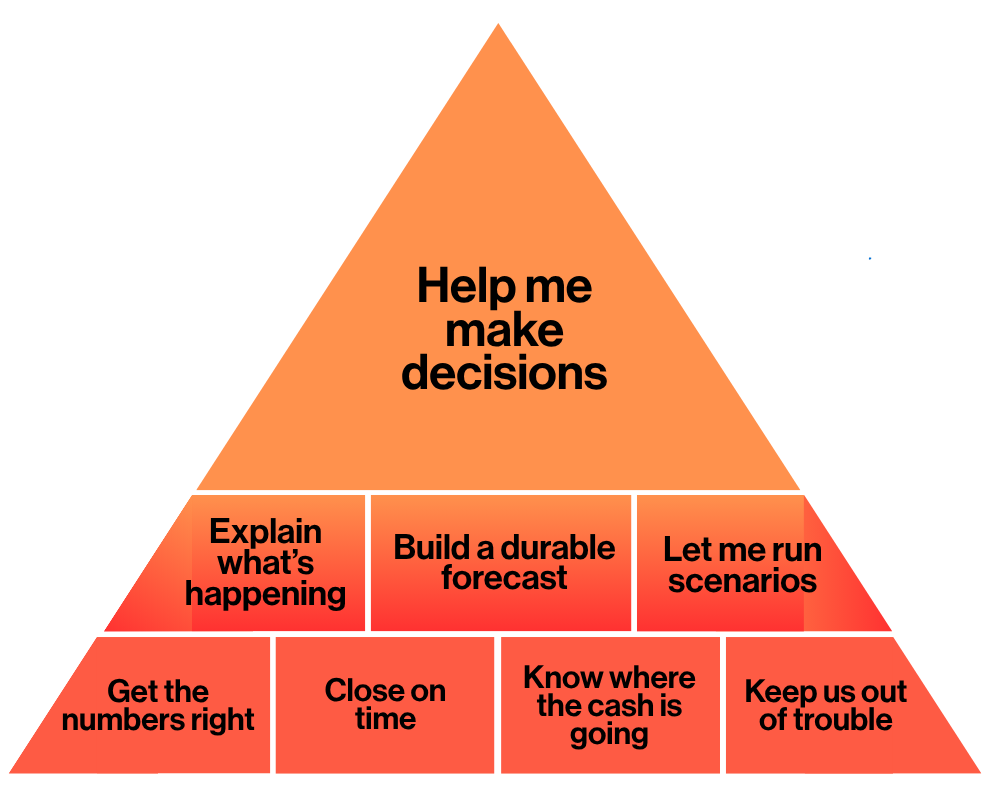
1. Get the numbers right
Accuracy is the foundation of credibility. If the financials are unreliable, all downstream analysis and decision-making is compromised.
Finance must consistently deliver clean P&L, balance sheet, and cash flow statements that are free from surprises, rework, or inconsistencies.
2. Close fast and consistently
Speed reflects control. A disciplined close process signals that the organization understands its financial position in real time.
An effective finance function operates with a predictable monthly close cadence, minimal post-close adjustments, and clear process ownership.
3. Know where the cash is going
Profitability alone does not ensure survival. Liquidity is critical.
CEOs require clear, timely visibility into cash position, along with forward-looking forecasts that anticipate changes in inflows and outflows. This includes disciplined management of burn and working capital.
4. Protect the downside
Risk management and compliance are often underappreciated until they fail.
A strong finance function implements effective controls, ensures regulatory compliance without creating unnecessary friction, and surfaces risks early.
5. Explain what is actually happening
Reporting alone is insufficient. Finance must interpret results and identify the underlying drivers of performance.
This includes clearly articulating what changed, why it changed, and what it means for the business. The emphasis should be on material insights, not exhaustive detail.
CEOs rely on finance to deliver clarity, not volume.
6. Build a forecast that holds up
A forecast should function as a decision-making tool, not a static model.
Effective forecasting is grounded in operational drivers, updated regularly, and accompanied by clear explanations of variances. It should provide a reliable view of where the business is heading.
7. Let me run scenarios to test outcomes
CEO’s want a forecast that is flexible enough to test scenarios. They need to pressure test assumptions before committing capital or changing direction.
That means the ability to quickly model upside, downside, and trade-offs across key drivers. Scenarios should be easy to run, grounded in reality, and tied to clear implications. Not static models that require days to update.
8. Translate numbers into decisions
At this stage, finance begins to operate as a strategic partner.
The role extends beyond analysis to framing trade-offs, guiding capital allocation, and modeling scenarios in advance of key decisions. Finance provides structure and rigor to complex choices.
The takeaway
Many finance teams attempt to move prematurely from operational execution to strategic influence.
In doing so, they create a gap between aspiration and capability—one that undermines credibility with leadership.
The most effective finance functions build a strong operational foundation first. They are disciplined and consistent at the base, which enables them to become trusted and indispensable at the top.
About the Author:
Karsten Loose is co-founder and Managing Partner at Karlon Group, a fractional finance and accounting firm that helps companies build, scale, and optimize their finance and accounting functions. Karlon Group works with companies across SaaS, e-commerce, manufacturing and technology, offering a full suite of finance and accounting support tailored to each client’s changing needs.