

Blog Series: The ROI-Driven Marketing Playbook
This is the third article in a five-part series about ad spend ROI, authored by Karlon Group. In the last article, The Early Days of Performance Marketing ROI, we discussed how to approach performance marketing ROI when resources and data are limited. We covered the basics of how to measure ad spend ROI for subscription and non-subscription businesses, over what time horizon, and how often. We examined the challenges of linking sales to specific ad channels, given the limitations of platform-based attribution models.
In this article, we’re going to dive deeper into attribution and explore how to get more scientific about estimating which channels actually drive sales. Attribution has become increasingly important as privacy regulations, data fragmentation, and the decline of cookie-based tracking make channel measurement less reliable. The good news is, modern software tools can help with much of the analytics. But before we dig into how the software works and which software to consider, let’s first talk about when in a company’s lifecycle it makes sense to invest in attribution tools.
Attribution software is a meaningful investment. It typically costs $1,000–$2,500 per month, and often more when you include the additional tools it inevitably requires. More importantly perhaps, attribution software introduces an additional layer of analytical complexity. With attribution software, you have the freedom to test different attribution models – for example time decay, linear, or proprietary variations – that assign credit to marketing touchpoints in different ways. This can lead to deeper insights, which is great, but can also require ongoing optimization cycles and cause analytics fatigue from managing multiple competing model frameworks.
Given the analytical baggage that comes with attribution software, it’s worth assessing whether you’re ready to make the most out of it. Before selecting attribution software, you should answer these two foundational questions:
- Do you have the resources to implement the software and interpret its results?
- Do you have the data and execution framework to act on those results?
To get the most out of attribution software, you’ll need at least one team member with deep expertise in performance marketing. Titles vary, but this person is typically referred to as a growth marketer, direct response marketer, or performance marketing lead. Among my clients who use attribution software, the ones that manage it effectively typically have two dedicated growth marketers on the team, one senior and one junior, working closely together.
Before adopting attribution software, you should also make sure your business has sufficient event volume and tracking consistency so that the models work properly. If you’re spending less than $250,000 per month of paid media, I would avoid attribution software altogether. You just don’t have enough data to feed the models.
Back to the question: what does attribution software do exactly? In a nutshell, attribution software tracks and analyzes how different marketing channels and touchpoints contribute to conversions so you can determine which channels drive the most sales. The software attempts to collect data on every touchpoint a user interacts with before making a purchase, from initial ad click to eventual conversion. This includes visits to landing pages, engagement with emails, organic search activity, and other interactions throughout the buyer’s journey. Then it determines how much credit to assign to each channel or touchpoint on the path to conversion. Touchpoints can include paid search, social media ads, email campaigns, organic search, and more. The volume and quality of the data fed into the model matter a lot (we’ll come back to this later).
Most attribution software allows users to choose from different attribution models, such as time decay, linear, or last-click. Software providers may also employ their own proprietary models, which go beyond the standard models to account for multi-channel, multi-device interactions. A typical model uses a combination of machine learning and advanced data modeling to provide deeper insights into how marketing channels work together to drive conversion.
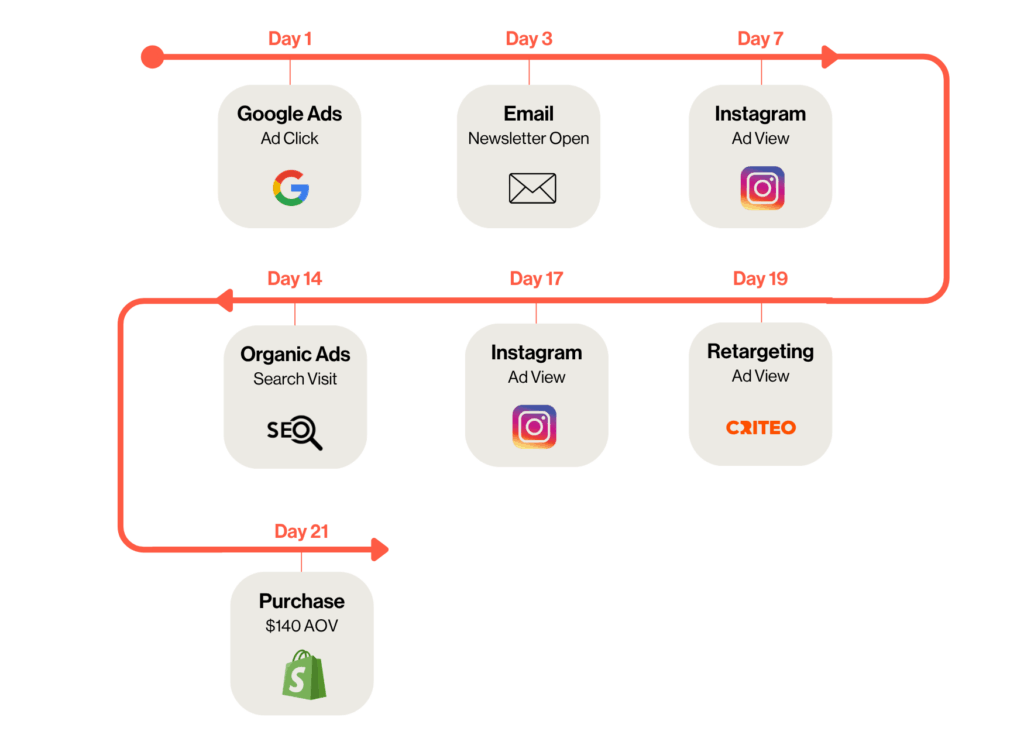
While attribution models are powerful, one knock against them is that they can feel overly statistical and prescriptive. Attribution models focus heavily on assigning quantitative credit to channels or campaigns based on statistical methods, but they often miss the qualitative narrative of how a customer actually moves from discovery to purchase. There’s no contextual view of how awareness builds, how customers compare options, or where friction occurs. In a future article, we’ll introduce the concept of customer journey mapping – a more exploratory, behavioral approach that complements attribution by helping you understand the customer experience in richer detail.
Choosing your attribution software
For early to mid-stage e-commerce startups, Northbeam is a popular option for “off-the-shelf” attribution software. It’s particularly well-suited for direct-to-consumer brands operating on Shopify that market via the major digital channels, such as Meta, Google, TikTok, and email/text.
Northbeam positions itself primarily as a multi-touch attribution (MTA) platform. It’s best known for is its “Universal Attribution” engine, which stitches together first-party data across clicks, impressions, and views, and enables marketers to measure multi-touch attribution across extended lookback windows. Among the advantages of Northbeam are its integration with first-party data, its ability to handle cross-channel attribution, and its modeling flexibility. Overall, Northbeam is a great starting point for brands that want to get more sophisticated about attribution.
Implementation of Northbeam can typically be completed in a few weeks by a capable marketing team, without requiring extensive data engineering support. The software integrates well with various platforms, including Shopify, Meta, Google Ads, and Klaviyo. While it doesn’t offer native integrations with Excel or Google Sheets, data can be exported and then imported into these tools as needed.
Northbeam’s pricing starts at ~$1,000 per month with tiers that adjust according to the volume of ad spend. This model allows startups to scale their usage as their marketing efforts grow.
Another vendor worth mentioning is Triple Whale. Triple Whale is tailored specifically to e-commerce brands on Shopify. It’s easy to use but its attribution modeling capabilities are relatively basic, often relying on simplified models that may not capture the full complexity of multi-touch customer journeys. Furthermore, its integration capabilities are somewhat limited to Shopify and the big ad platforms, whereas Northbeam offers broader data ingestion options and more flexible data export functionalities. A lot of companies are attracted to Triple Whale initially because it’s user-friendly, but then eventually have to upgrade to Northbeam as they get more sophisticated. I recommend skipping this step and going straight to Northbeam as a starting point.
Attribution tools like Northbeam and Triple Whale provide an analytical surface layer. To improve attribution accuracy, your analytics stack needs a well-structured analytics foundation that captures clean, event-level data. You should begin with client-side pixels, small pieces of code embedded on your website that track user interactions. These pixels are critical because they provide the raw behavioral data that powers attribution models, allowing you to tie marketing efforts directly to customer actions on your site. As you mature, you should layer in tracking infrastructure such as data warehouses, UTM parameters, CRM integrations, and identity resolution platforms. These tools improve both the accuracy and breadth of data that feed into a company’s attribution and targeting models. They help companies stitch together a more robust picture of a customer’s journey across devices and over time, particularly when purchases happen weeks after the first ad impression.
In this article, we’re not going to walk through the entire ecosystem of data tools, but it’s worth mentioning a few and why they’re important.
Identity resolution software is an increasingly critical tool for customer tracking and attribution models. The deprecation of third-party cookies and growing restrictions on cross-site tracking means that marketers can no longer rely on platform-provided attribution or cookie-based device stitching. Instead they must turn to identity resolution software to unify anonymous and known identifiers, build accurate identity graphs, and maintain visibility into the full customer journey across devices and channels. Without that capability, attribution models risk missing key touchpoints or mis-assigning attribution credit.
At its core, identity software helps you consolidate scattered customer identifiers into a cohesive profile, minimizing duplicates and inconsistencies. Identity software allows you to create a more accurate identity graph for your customers, a clean “who is who” backbone, with purchases stitched across channels. As marketing channels’ self-reported attribution metrics become less and less reliable, identity software has become increasingly important.
RudderStack is a popular software platform that includes identity stitching within its CDP. Its strength lies in data collection, unification, and activation across systems. Its core product offering enables analytics teams to capture user behavior across web, mobile and other touchpoints, unify that data in a data warehouse, and then push it downstream to marketing and analytics tools. RudderStack is best known for its open-source, “warehouse-first” architecture (meaning you maintain ownership of your data rather than relying on a proprietary vendor-cloud), and its ability to support real-time event streaming, transformations, identity stitching and activation. The platform tends to be complex to implement and run because you’re managing more of the plumbing (data warehouse, transformations, schemas), so consider this a more customizable solution for marketers that have technical resources to support them.
In terms of pricing, RudderStack uses a usage-based model structured around event volume and feature tiers. Expect to pay another ~$1,000 per month at least for this software.
Another popular software tool in the ecosystem is Segment. Segment isn’t attribution software, it’s a Customer Data Platform (CDP). Segment collects, cleans, and unifies customer data from multiple touchpoints – websites, mobile apps, servers, third-party tools, and more. This unified view ensures attribution software receives consistent and high-quality data, which is crucial for accurate attribution modeling. CDPs are also critical for gathering intelligence that can inform both tactical execution and broader strategy.
For B2C SaaS companies, the attribution surface layer should include tools such as AppsFlyer and Windsor.ai. Apps Flyer provides attribution tools for companies where customer acquisition via mobile apps is prevalent. Windsor.ai is a versatile tool that includes multi‑touch attribution modelling and connects with 300+ marketing & analytics sources. If you’re operating on a home-built platform, you’ll similarly want to make sure you have a clean event-tracking layer using tools like RudderStack and Segment. You may also need to invest earlier in a data warehouse, such as Snowflake or AWS, to collect and unify user events (site visits, trial starts, upgrades, cancellations). From there, integrating an attribution platform such as Adobe Marketo Measure, Dreamdata or Funnel.io will allow you to connect marketing spend data with subscription metrics captured on Stripe. You can then push these unified datasets into a business intelligence tool like Looker or Tableau for cohort and LTV analysis. The key is ensuring all customer lifecycle events – from ad click to subscription renewal – are tied to a persistent user ID so you can understand acquisition efficiency over time.
For B2B SaaS companies, attribution is slightly different. B2B sales often rely on human-driven touchpoints such as demos, discovery calls, and multi-stakeholder approvals. This makes it harder to attribute revenue purely through digital tracking. To solve this, many B2B SaaS companies use attribution software to figure out what channels drive leads instead of revenue. This approach works because leads, for example demo requests or sign-ups, are often digital-stage conversion events that can be directly tied to marketing campaigns through standard tracking methods. More sophisticated B2B SaaS companies will also pair marketing attribution software with a CRM system such as Salesforce or HubSpot is essential to capture both digital signals and offline interactions, giving a more complete view of the buyer journey.
In summary, as you scale your business and marketing team, you will eventually need to move beyond last-click heuristics and get sophisticated about attribution. Attribution can be complex and relies heavily on software. The key is pairing sophisticated measurement tools with disciplined execution and the right team structure. By building on clean data, aligned systems, and sound interpretation, you’ll convert attribution insight into measurable growth.
Key points:
- Attribution software tracks multi-touch customer journeys by collecting data across all marketing touchpoints, from initial ad clicks to final conversions, and assigning credit to different channels using models like time decay, linear, or proprietary machine learning approaches.
- Attribution software is a significant investment, costing $1,000–$2,500+ per month at least and probably more when you include ancillary tools. Companies should have at least $250,000 per month in ad spend and a dedicated growth marketer (ideally two) on the team before adopting these tools
- Attribution objectives vary by business model. For direct-to-consumer e-commerce companies, the goal is to link paid media on platforms like Meta, Google, TikTok, and Klaviyo to purchases on Shopify, using tools like Northbeam and Triple Whale to model and assign credit across the customer journey. For consumer SaaS companies, attribution often focuses on connecting acquisition spend to in-app behavior and subscription lifecycle events using tools like AppsFlyer and Windsor.ai. For B2B SaaS companies, the emphasis is on attributing marketing efforts to lead generation using attribution tools such as Adobe Marketo Measure, Dreamdata, and Funnel.io, sometimes paired with CRMs like Salesforce or HubSpot to track how leads convert to revenue.
- Attribution models have their limitations, as they focus heavily on a purely statistical approach to assigning credit to each channel and often miss the qualitative narrative of how customers actually move through their journey.
- Across all three business models, tools like Segment and RudderStack are essential for collecting, cleaning, and unifying event-level data to ensure attribution models have accurate, high-quality inputs. Identity resolution software is increasingly critical as third-party cookies deprecate and cross-site tracking restrictions grow.
- Clean data infrastructure is essential for attribution accuracy. Companies need event-based tracking foundations including client-side pixels, data warehouses, UTM parameters, CRM integrations, and identity resolution platforms to capture the full customer journey.
- Success requires the right combination of sophisticated measurement tools, disciplined execution, clean data systems, and proper team structure to convert attribution insights into measurable business growth.
About the Author:
Karsten Loose is co-founder and Managing Partner at Karlon Group, a fractional finance and accounting firm that helps companies build, scale, and optimize their finance and accounting functions. Karlon Group works with companies across SaaS, e-commerce, manufacturing and technology, offering a full suite of finance and accounting support tailored to each client’s changing needs.