

Co-Authored with Ariel Jalali, CEO of Paragon and Chris Shimojima, CEO of C5 Advisory
Executive Summary
The modern CFO faces an unprecedented challenge: CEOs demand “We need AI now!” while 88% of AI initiatives fail to reach production. This white paper provides a strategic framework for CFOs to successfully position their CEO, Board of Directors, and Executive Leadership Team for AI transformation success through cost quantification, ROI analysis, and trade-off modeling.
The AI Time Bomb
ChatGPT, Claude, and Gemini have made it easy for everyone to experience AI’s capabilities. But what is not well-understood are the requirements to develop an effective AI platform and the risks of ignoring them. The most basic requirements are high quality data and clear business requirements – what problem should AI solve. 42% of companies are abandoning most AI initiatives in 2025 (up from 17% in 2024) due to poor data quality, inadequate risk controls, and unclear business value. The average organization scraps 46% of AI proof-of-concepts before production, with only 4 out of 33 POCs reaching deployment (IDC/Lenovo study, March 2025). Yet 68% of CEOs identify integrated enterprise-wide data architecture as critical (IBM CEO Study, 2025).
The CFO’s Unique Value
The CFO role has fundamentally changed – shifting from 80% backward-looking activities in 1990 down to 40% today. CFOs, becoming the company’s de facto ‘Chief Data Analytics Officer.’ While CIOs typically “own” data through BI, CFOs are better positioned organizationally and skill-wise to be the CDO.
Furthermore, AI ownership is a natural extension to the CDO role since AI input and output are both “data”. This creates “Moneyball” analytics – proprietary insights that become competitive moats.Moreover, CFOs are uniquely positioned to succeed through systematic stakeholder management, owned data platform strategies, and small experiment methodologies that avoid big bang IT failures. While CTOs handle technical feasibility and business leaders identify opportunities, only the CFO can quantify true costs, define realistic ROI expectations, and model trade-offs between investment options without bias.

I. Why AI-forward CEOs Need a Finance Business Partner
What Your CEO is Experiencing:
- Board pressure: 64% of CEOs made AI their top investment priority in 2024 (KPMG CEO Outlook)
- Board pressure: 64% of CEOs made AI their top investment priority in 2024 (KPMG CEO Outlook)
- Technology enthusiasm without quantified cost analysis
- FOMO – Fear of Missing Out: This is a classic CEO “new shiny object” syndrome. 64% of CEOs acknowledge that the risk of falling behind has impacted technology investment decisions, while 61% of CIOs admit their investments are frequently driven by FOMO (IBM/Ardoq, 2024)
- Investment appetite without realistic ROI expectations
- Multiple AI proposals without clear trade-off comparisons
The Hard Truth About AI Investment:
- AI will reshape workforce composition – some roles eliminated while others emerge requiring new skills for data analysis and AI oversight – quantifying this workforce transformation requires financial analysis
- Implementation costs compound beyond initial estimates – CFO modeling prevents surprises
- ROI timelines extend longer than projected – realistic expectations prevent disappointment
- Trade-offs between build vs. buy require comprehensive analysis
- AI activities are not grounded in strategic intent. AI for the sake of AI does not generate incremental value
Translating “We Need AI!” Into Actionable Analysis
When the CEO Says: “We need AI!”
CFO Response Framework: “Help me understand what ‘doing AI’ means for our business model so I can model specific investment options with measurable outcomes.”
“Let me model three specific AI investments: a $180K predictive analytics pilot that improves our budget accuracy by 35%, a $280K contract analysis system that reduces legal costs by $420K annually, and a $220K pricing engine that delivers 3-5% margin improvement. Each has different risk profiles and timelines. Which business outcome is your priority?”
Making the Mandate Specific:
- Business Problem Identification: “What specific business problem are we solving? Examples: Our demand forecasting is 20-30% off actuals contributing to excess inventory costs, our month-end close takes 15 days when competitors finish in 5, or our pricing decisions lack real-time market data causing margin erosion.”
- Strategic Differentiation: “How does this AI investment create competitive advantage rather than just operational efficiency? What makes this strategically different from what competitors can easily replicate?”
- Competitive Response: “Which competitors are we responding to and what measurable advantages are they gaining?”
- Success Definition: “What’s our success metric? 10% cost reduction? 15% revenue increase? Faster month-end close?”
- Timeline Expectations: “Are we looking for quick wins in 6 months or transformation over 2 years?”
- Risk Parameters: “What’s your risk tolerance? $200K experiments or $2M platform investments?”
CFO’s Practical Translation Process
Step 1: “Let me identify our top 3 AI opportunities with ROI projections and confidence levels”
Step 2: “Here’s how each option addresses your business priorities with quantified outcomes”
Step 3: “We should start with a $200K incremental experiment next quarter that delivers measurable results”
Transforming CEO Urgency Into Investment Decisions
- Board Pressure → CFO creates board-ready AI investment plan with risk-adjusted returns
- Competitive Anxiety → CFO models specific competitive response options with implementation timelines
- Transformation Vision → CFO structures phased approach with quarterly milestones and go/no-go criteria
What Makes a CFO’s Finance Partnership Irreplaceable
- Cost Quantification: You see the full economic picture – implementation, maintenance, opportunity costs, and hidden expenses without departmental bias
- ROI Modeling: You can model realistic timelines, probability-adjusted returns, and sensitivity analysis independent of project advocacy
- Trade-off Analysis: You can compare investment options across different time horizons and risk profiles without political considerations
- Risk Quantification: You can model financial impact of failure scenarios and mitigation costs from an organizational perspective
- Strategic vs. Tactical KPI Framework: CFOs can identify the critical strategic KPIs that drive organizational success, then map the tactical and operational metrics that feed into those strategic outcomes.
No other executive delivers this decision support – CTOs advocate for technical solutions, business leaders champion their initiatives, but only the CFO delivers unbiased financial analysis. CFOs are perfectly positioned to “connect the dots.”

II. Positioning Yourself as the CEO’s Financial Partner in AI Transformation
Reframe Your Role as CEO’s Financial Partner in AI Transformation:
Instead of: “AI will cost $X and may not work” Say: “Here’s the finance analysis: three AI investment scenarios with estimate ROI timelines, implementation costs, and trade-off considerations between build vs. buy options”
Instead of: “We should be careful about AI spending” Say: “As your finance partner, I’ve modeled two scenarios: Option A will cost $200K, delivers an 12-month estimated payback and a 25% ROI in year 2, while Option B will cost $2M, delivers an 30-month estimated payback, but is expected to have a 35% ROI by year 5”
AI investment should deliver strategic value first. The business case must show HOW the investment advances organizational strategy, not just financial returns.
The Business Case Analysis
CFOs must translate AI opportunities into comparable investment scenarios. The following framework provides a systematic approach to evaluate AI initiatives based on financial returns, implementation risk, and strategic impact.
S&OP: Target-Rich Environment for AI Value Creation
Sales & Operations Planning represents the highest-impact area for AI investment because it directly drives capital efficiency and value creation. S&OP processes touch every aspect of the business – demand forecasting, inventory optimization, production scheduling, and capacity planning. AI applications in S&OP deliver measurable ROI through working capital reduction, improved forecast accuracy, and operational efficiency gains. For CFOs, S&OP AI projects offer clear financial metrics: inventory turns, forecast variance, capacity utilization, and working capital optimization. These investments create compound value – better demand planning reduces inventory costs, which improves cash flow, which enables growth investments.
Table 1 – CFO AI Investment Comparison Tool (EXAMPLE)
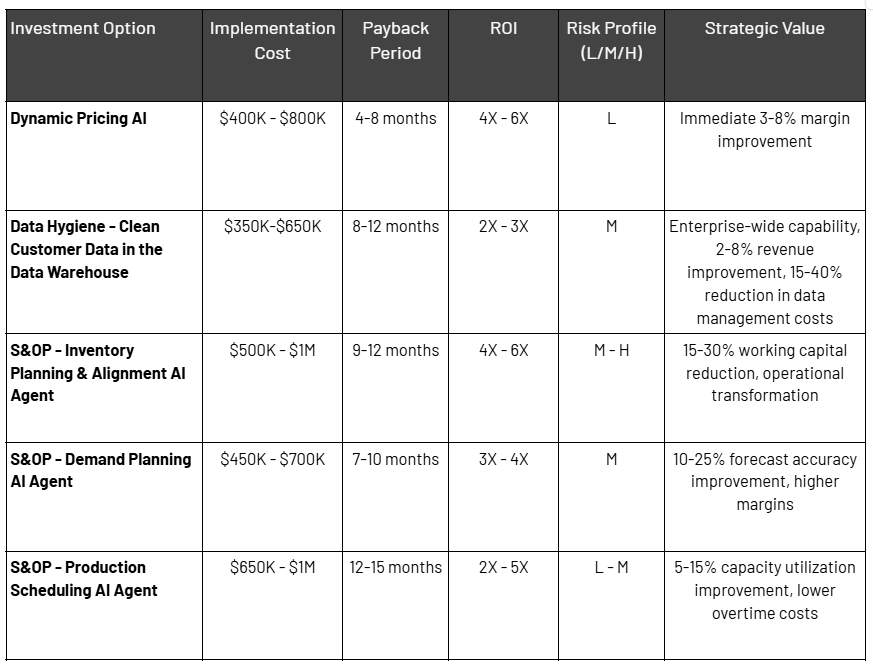
Best Quick Win (4-8 months):
- Dynamic Pricing AI: High confidence, immediate 3-8% margin improvement, low risk profile with 4X-6X ROI
- S&OP – Demand Planning AI Agent: 10-25% forecast accuracy improvement leading to higher margins with moderate risk
Highest ROI Potential (8-12 months):
- S&OP – Inventory Planning & Alignment AI Agent: 4X-6X ROI with 15-30% working capital reduction and operational transformation
- Data Hygiene – Clean Customer Data: Enterprise-wide capability enabling 2-8% revenue improvement and 15-40% reduction in data management costs
PE Portfolio Company Approach:
- Start with: Dynamic Pricing AI ($400K-$800K) – Immediate margin impact with low risk and fast payback
- Layer on: S&OP Demand Planning ($450K-$700K) – Better forecasting accuracy and margin optimization
- Scale to: S&OP Inventory Planning ($500K-$1M) – Working capital optimization and operational transformation
CFO’s Role in Options Modeling: Your job as CEO’s financial partner is not to greenlight a single path, but to quantify multiple viable options with clear trade-offs. This decision support is your unique organizational value – no other executive provides unbiased financial analysis across competing initiatives:
- Present 2-3 financially viable scenarios with different risk/return profiles without advocacy bias
- Model both conservative (MVP/pilot) and aggressive (full build) approaches
- Compare internal development vs. vendor solutions with total cost of ownership analysis independent of vendor relationships
- Give CEO financial clarity to choose based on priorities and risk tolerance, supported by unbiased data
III. Supporting Board Decision-Making Through Financial Analysis
What Board Members Need from Your Financial Analysis:
- Clear cost quantification with confidence intervals that supports CEO strategy
- Realistic ROI expectations with confidence level assessment that enables board comparison
- Trade-off analysis between competing investment priorities
- Risk quantification with financial impact scenarios that support leadership decisions
Why AI Initiatives Fail (Finance Perspective):
- Poor Cost Estimation: Organizations underestimate total implementation costs by average 47%
- Unrealistic ROI Expectations: Projected timelines typically 60% shorter than actual realization
- Inadequate Trade-off Analysis: Decisions made without comparing alternative investment returns
IV. Financial Analysis for Technology Investment Strategy
Cost Quantification for Build vs. Buy Decisions
Owned Platform Investment Analysis:
- Upfront Costs: Development resources, infrastructure, training, risk mitigation
- Ongoing Costs: Maintenance, updates, scaling, support
- Opportunity Value: Asset creation, competitive moat development, IP portfolio value
- Comparative Analysis: Total cost of ownership vs. SaaS subscriptions over 3-year horizon
Trade-off Modeling Examples:
- “Contract Analysis LLM: $280K-$380K co-investment with CTO vs. $180K-$240K annual legal services fees. Break-even at 18 months, plus 60% faster M&A due diligence valued at $200K per transaction”
- “Predictive Analytics Platform: $320K-$450K development partnership with technology team vs. $190K-$280K annual vendor solution. Owned platform improves budget accuracy by 35% and enhances investor reporting quality”
Supporting CEO and CTO Partnership
- The CTO’s Resource Allocation Challenge: Most CTOs manage IT budgets spread across competing priorities: technical debt paydown, infrastructure upgrades, new AI initiatives, system maintenance, and security improvements. While CTOs understand technical feasibility and implementation requirements, they often lack the financial modeling to quantify business impact across these competing investments.
- CFO as CTO’s Strategic Resource Allocation Partner: Your unique value to the CTO is translating technical improvements into quantified business impact. CTOs know what’s technically possible – you know how to measure what’s financially worthwhile. This partnership enables better resource allocation decisions across the entire technology portfolio.
Practical CFO Support for CTO Decision-Making:
Technical Debt vs. New AI Capability Analysis:
- Technical Debt Quantification: Model the cost of manual workarounds, system downtime, developer productivity loss, and maintenance overhead
- Example: “Legacy billing system technical debt costs $340K annually in developer time and $180K in manual processing vs. $420K to modernize with 24-month payback”
- New AI Investment Comparison: “Customer analytics AI requires $280K investment with $480K annual return vs. billing system upgrade with $520K annual savings”
Initiative Prioritization Across Technology Portfolio:
- CTO presents 8-12 competing technical projects
- CFO models ROI, implementation risk, and resource requirements for each
- Joint priority ranking based on risk-adjusted returns and strategic value
Example Portfolio Analysis:
- Database modernization: $580K cost, $720K annual savings, 18-month payback
- AI contract analysis: $280K cost, $420K annual savings, 12-month payback
- Security infrastructure: $390K cost, $180K annual savings + risk mitigation value
Breaking Large Technical Initiatives Into Financial Experiments:
CTO Vision: “We need a comprehensive data platform for AI initiatives”
CFO Experiment Structure:
- Phase 1: Data quality assessment tool ($150K, 3 months) – validates data readiness
- Phase 2: Predictive analytics pilot ($280K, 6 months) – proves business value
- Phase 3: Full platform deployment ($650K, 12 months) – scales proven capabilities
Partnership Dynamics:
- CFO provides: Cost analysis, ROI modeling across all technology investments, trade-off quantification between technical debt and new capabilities, business case development for CEO approval
- CTO provides: Technical feasibility assessment, implementation planning, resource requirements, timeline estimates, technical risk evaluation
- Joint delivery: Prioritized technology roadmap that maximizes business value while addressing technical requirements
Partnership Structure:
- CFO funds and supports technical team development based on quantified business cases
- CTO leads technical implementation while CFO tracks financial performance against projections
- Shared accountability to CEO for technology portfolio ROI and technical capability development
- CFO provides financial oversight and business justification while CTO manages technical execution and team development
CFO Value to CTO:
- Translate technical improvements into business language for CEO approval and budget allocation
- Provide financial justification for CTO’s technical recommendations beyond “we need this for the architecture”
- Help CTO avoid “shiny object” syndrome by focusing on highest-ROI technical investments
- Structure large technical visions into manageable experiments with clear financial success criteria
- Address workforce development pipeline challenges – Matt Bean’s “The Skill Code” highlights how AI eliminates entry-level jobs in accounting, law, and consulting, requiring CFOs to model investment in alternative pathways for developing senior executive talent
V. Implementation Through Small Experiments
Small Experiment Methodology – 90-Day Cycles:
Month 1: Design and Launch
- Week 1-2: Complete financial analysis for 2-3 small experiment options
- Week 3: CEO decision on highest-ROI experiment based on CFO modeling
- Week 4: Launch experiment with defined success metrics and go/no-go criteria
Month 2: Track and Measure
- Weekly: Financial performance tracking vs. projections
- Mid-month: Variance analysis and course correction if needed
- Month-end: Updated ROI projection based on actual results
Month 3: Evaluate and Scale Decision
- Week 1-2: Complete financial assessment of results vs. projections
- Week 3: Scale/kill/modify decision based on financial performance
- Week 4: Plan next experiment or scaling investment
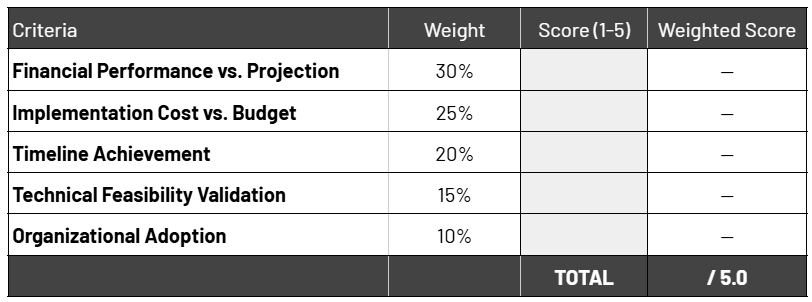
CFOs need a systematic approach to evaluate AI experiment performance against projections. This scorecard provides weighted criteria to make objective scale/kill/modify decisions based on financial and operational results.
Table 2 – Small Experiment Evaluation Rubric (CFO Scorecard)
Decision Process:
- 4.0-5.0: Scale immediately with full investment
- 3.0-3.9: Modify and re-test with additional 90-day cycle
- 2.0-2.9: Pause and redesign fundamental approach
- Below 2.0: Kill experiment and apply learnings to next option
Sample Calendar:
January: Pricing Engine Pilot
- Investment: $150K-$200K
- Success Metric: 2-3% margin improvement on pilot product line
- Go/No-Go: End of March based on actual margin impact
February-March: Real-time Cash Flow Dashboard
- Investment: $80K-$120K (parallel to pricing engine)
- Success Metric: Reduce cash forecasting time by 60%
- Go/No-Go: End of March based on time savings measurement
March Evaluation:
- Pricing engine: Achieved 2.8% margin improvement (exceeds 2% target) → Scale
- Cash flow dashboard: 45% time reduction (missed 60% target) → Modify and re-test
Month 4: Scale Successful Experiments
- Deploy company-wide implementation of Q1 winners (score 4.0+)
- Launch 2 new small experiments based on learnings
- Continue monitoring scaled implementations
Month 5-6: Portfolio Optimization
- Financial modeling for 2-3 additional small experiments with comparative ROI analysis
- Resource allocation between scaling proven winners vs. testing new options
- Quarterly portfolio review with CEO on experiment results vs. traditional IT ROI
Small Experiment Portfolio Management:
- Active Experiments: Maximum 3 concurrent to maintain focus and CFO oversight capacity
- Investment Threshold: $150K-$250K per experiment to ensure meaningful but contained risk
- Success Rate Target: 60%+ experiments achieving 3.0+ score (industry AI failure rate is 88%)
- Portfolio ROI: Combined experiment portfolio outperforming traditional IT investments
Financial Value to CEO:
- Clear investment prioritization based on quantified returns that enables confident decisions
- Realistic expectation setting with probability-adjusted projections that supports CEO communication
- Trade-off analysis showing opportunity costs that enables resource allocation
VI. Closing Thoughts
Hopefully this paper has given you a framework to lead your organization’s AI transformation in partnership with your CEO and CTO.
The companies that win won’t have the best technology – they’ll have CFOs who translate AI possibilities into business realities through disciplined analysis and strategic focus.
Your CEO is under intense board pressure to “do AI” but relies on you to provide the financial framework for smart decisions. Your CTO understands what’s technically possible but needs your help quantifying business impact across competing priorities. Your board wants confidence that AI investments will deliver measurable returns, not just technological novelty. You’re uniquely positioned to be the bridge between all three – the financial partner who can model realistic scenarios, the strategic advisor who connects AI to business outcomes, and the disciplined voice that ensures experiments prove value before scaling.
The framework is clear: become the Chief Data Officer first, focus on target-rich areas like S&OP that drive capital efficiency, use 90-day experiments to prove ROI, and position AI as strategic differentiation rather than operational catch-up. Your organization’s AI success depends not on having the latest technology, but on having a CFO who can navigate the transformation with financial rigor and strategic clarity. That CFO is you. Best of luck!
About the Authors:
Karsten Loose is co-founder and Managing Partner at Karlon Group, a fractional finance and accounting firm that helps companies build, scale, and optimize their finance and accounting functions. Karlon Group works with companies across SaaS, consumer, manufacturing, and technology, offering a full suite of finance and accounting support tailored to each client’s needs.
Ariel Jalali is CEO of Paragon, a leading platform that helps companies integrate, automate, and scale their software workflows. Paragon works with technology-driven businesses across SaaS, e-commerce, and enterprise, enabling them to streamline operations, reduce manual effort, and accelerate growth through seamless automation and integration solutions.
Chris Shimojima is CEO of C5 Advisory, a strategic advisory firm that helps companies accelerate growth, strengthen go-to-market execution, and optimize organizational performance. C5 Advisory partners with businesses across consumer, retail, technology, and services, providing tailored guidance to unlock new opportunities and drive sustainable results.